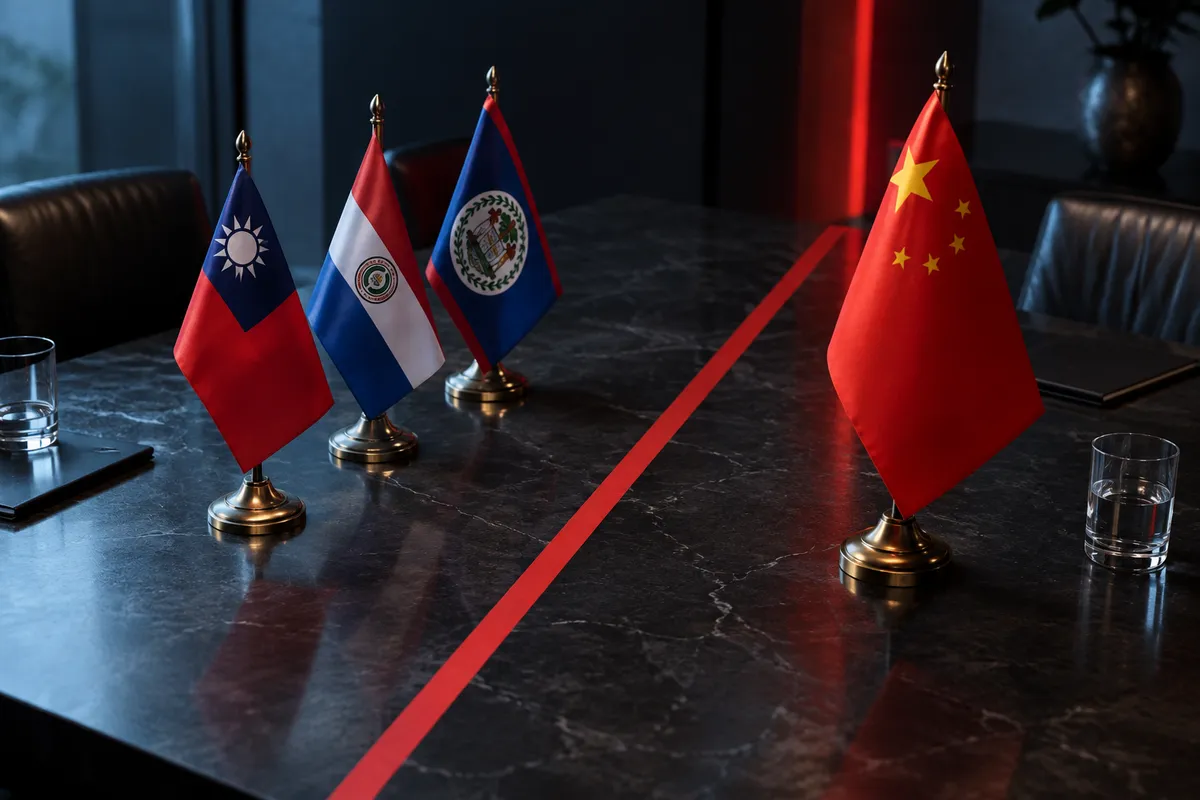
China has sanctioned two government ministers from countries that formally recognize Taiwan: Paraguay's communications minister, Gustavo Villate, and Belize's foreign minister, Francis Fonseca. According to Al Jazeera, the measures freeze assets and restrict entry to Hong Kong and Macau. The Chinese Foreign Ministry cited national sovereignty and what it called Taiwan separatist activities as the reasons.
This is a sober subject, so the register here stays sober. The question worth asking is why Beijing would spend diplomatic energy on officials from two comparatively small countries.
The story: Who, What, and When
Per Al Jazeera's reporting, the sanctions target Villate and Fonseca over their countries' diplomatic ties with Taiwan. The practical effects are asset freezes and entry restrictions to Hong Kong and Macau. The report frames the move as part of Beijing's broader campaign to isolate Taiwan and to punish officials who publicly support it.
The timing is notable. The sanctions come just after Taiwan's National Day, and amid renewed rhetoric from China about "reunification." They also land as Taiwan boosts its defense ties and capabilities, including recent US fighter jet deliveries, according to the same report.
Why Small Allies Carry Big Weight
The angle that explains this best is arithmetic. Taiwan has 12 diplomatic allies, per Al Jazeera's framing, and Paraguay and Belize are among them. When a list is that short, every entry counts for much more than its population or economy would suggest.
Formal recognition is the currency in this contest. Each country that recognizes Taipei is a country that has not switched to Beijing, and each one that does switch is a visible win in China's campaign. It's hard not to read sanctions on individual ministers as a different tool aimed at the same goal: making public support for Taiwan carry a personal cost.
A Targeted Tool
Sanctioning a minister, rather than a whole country, is a pointed choice. Freezing assets and limiting travel to Hong Kong and Macau are measures that land on named individuals. The message, as the coverage describes it, is aimed at officials who speak up for Taiwan. That is our reading of the design, but the pattern the report describes fits it: the pressure is personal and the audience is every other official watching.
The Timing Is Part of the Story
Taiwan's National Day is an annual moment when the island's international standing gets attention. Sanctions arriving right after it, alongside fresh talk of "reunification" from Beijing, make the sequence look less like coincidence and more like a signal. Al Jazeera doesn't claim a deliberate link, and neither should we, but the proximity is difficult to ignore.
Then there's the defense side. Taiwan has been strengthening its military ties and capabilities, including receiving US fighter jets recently. That context shapes how Taiwan's remaining partners are viewed by both capitals: as diplomatic friends, and as part of a standoff in which US support is a constant background factor.
Caught in Great-Power Politics
For Paraguay and Belize, the sanctions are a reminder of how a decision about recognition made in one's own interest can draw consequences from a much larger power. Villate runs communications in Asunción; Fonseca leads foreign affairs in Belmopan. Neither is a household name abroad, and that is rather the point. Beijing's message appears to be that no rank is too low to be noticed.
What the report does not tell us, and what we can't responsibly guess, is how the two governments will respond, or whether more officials could be targeted. Those are the developments to watch over the coming days.
The Takeaway
In a diplomatic contest decided one recognition at a time, a dozen allies is a thin margin, and a sanction on a single minister is a way of telling the other eleven what public loyalty might cost. Whether that pressure persuades or hardens resolve is the open question behind this week's news.