Your toddler has probably already asked Alexa a question. Maybe several hundred. According to a PBS report this week, researchers and other experts are now turning their attention to the youngest AI users, and their advice for parents boils down to one steady idea: help kids understand that the thing talking back to them is not a person.
The story: AI Is Already in the Playroom
PBS reports that AI shows up in children's daily lives through smart speakers like Alexa and platforms like YouTube, and that AI toys are part of the picture too. Much of the parenting guidance out there, the report notes, focuses on older kids. Experts are now working to fill the gap for children under 8, a period of critical brain development.
The capacity to learn from technology starts early. Lauren Girouard, a researcher at Harvard Graduate School of Education and the University of Michigan, said that by the time a child is preschool age, they have the ability to learn information from technology.
That's the double edge here. Kids can pick things up from a screen or a speaker, which is exactly why what they pick up matters.
Our Angle: Start With the Speaker You Already Own
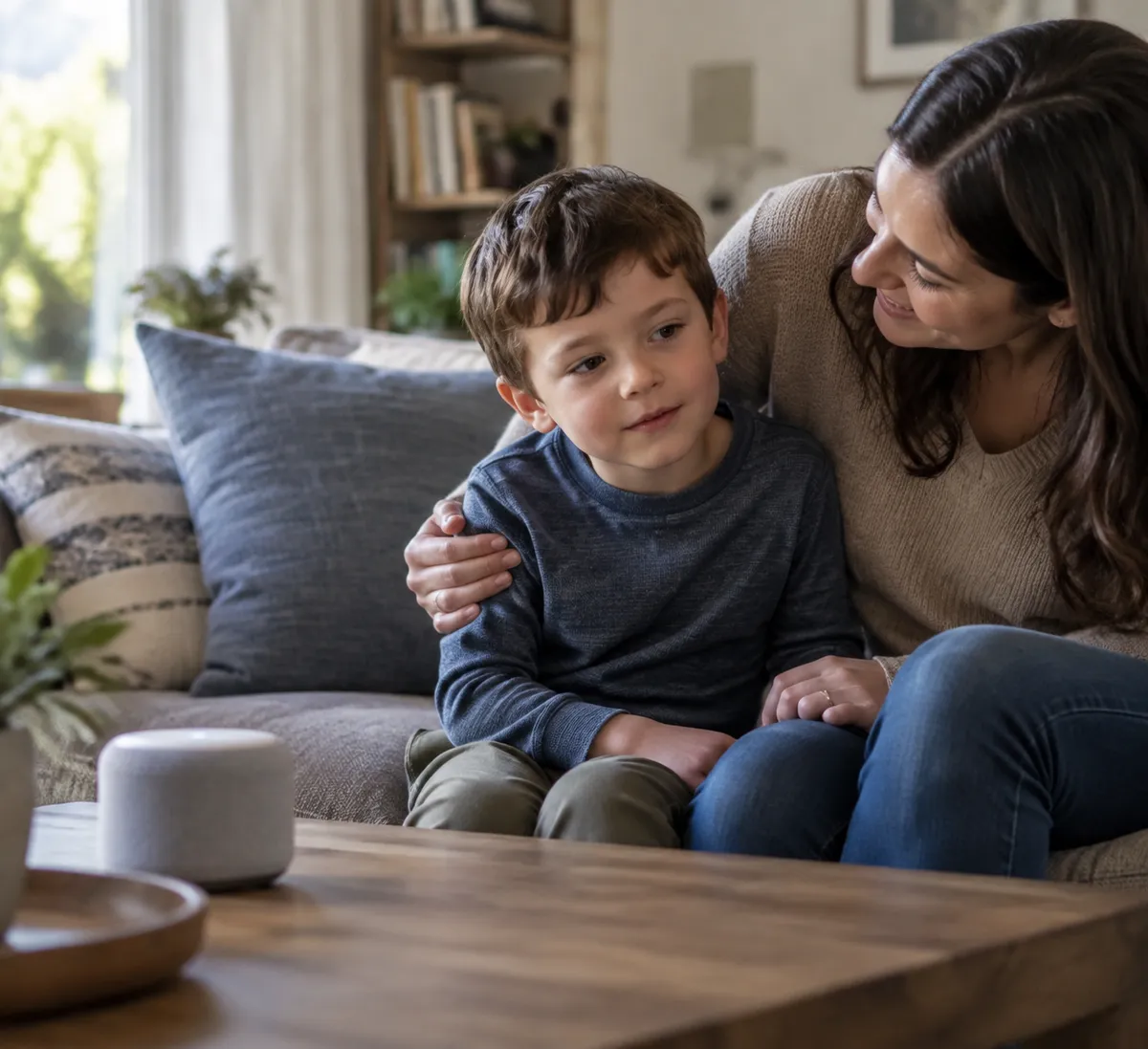
Of all the angles on offer, the most practical one is also the least intimidating: use the smart speaker already on your kitchen counter as a teaching tool. No new gadget, no special curriculum. Just a regular Tuesday and a kid asking a robot about dinosaurs.
The experts' core goal, per PBS, is helping children grasp the difference between how a human responds and how a computer responds. It's hard not to see the appeal. A smart speaker is a low-stakes place to practice a high-stakes idea.
What to Say
The advice centers on age-appropriate language that makes clear AI isn't human. The points highlighted in the report: AI doesn't feel sad, doesn't have a body, and doesn't understand snuggling.
That last one is oddly perfect. Kids under 8 live in a world organized around snuggles, and telling them a voice from a speaker can't actually get one is a concrete, kid-sized way to draw the line. (Our take: this is a much better pitch than a lecture on machine learning, which would lose a four-year-old by the second sentence.)
A few ways a parent might put that into practice, as our own spin on the experts' framing:
- When the speaker answers a question, point out that it's a computer finding a response, not a friend thinking about you.
- If your child says the speaker must be sad or happy, gently remind them that it doesn't have feelings or a body.
- Treat it like any other tool in the house: useful, but not someone.
Why Humans Still Win: The Scaffolding Idea
The PBS piece stresses that human interaction remains crucial for healthy development. One concept experts return to is scaffolding: a person guiding a child through learning, adjusting support as the child grows. According to the report, human-guided learning beats AI interaction when it comes to language, emotional and social development.
Think of it this way, and this is our analogy, not the experts': a speaker can answer a question, but a grown-up can notice the confused face that came before the question, then follow up. That back-and-forth is the part a device can't replicate.
It also quietly punctures a popular myth. The pitch that AI is a developmental boost for little kids sounds great in marketing copy. The experts quoted by PBS push back, emphasizing that people, not programs, are what young brains need most.
The AI Toy Problem
PBS flags AI toys as posing developmental risks, and experts recommend that parents lean on human alternatives instead. The reporting we have doesn't spell out every risk, so we won't invent a list. But the logic fits with everything above: a toy that talks like a companion could blur the very line parents are trying to draw between a person and a product.
It's the Toy Story fantasy in reverse. Woody's charm was that he came alive when nobody was looking. A talking toy that's marketed as alive, to a child who is still working out what alive means, is a different proposition. The practical alternative is simple and unglamorous: play with your kid, or set up play with other kids.
Spotting "AI Slop" in Kids' Content
YouTube is on the list of places kids meet AI, and the experts' guidance includes watching for red flags in AI-generated children's content, the low-quality material often called "AI slop." The details of specific warning signs aren't spelled out in the information we have, so rather than guess, the safest takeaway is the general one: watch along sometimes, and pay attention to what your child is actually being served rather than assuming it was made with care.
The Takeaway
None of this requires banning the speaker or panicking about the playlist. The experts' message, as PBS relays it, is calm and fairly old-fashioned: narrate the technology, keep humans at the center, and be honest with small kids about what a machine is.
The neatest part is the ending of that conversation. When your child asks whether Alexa wants a hug, the best answer is the true one: no, it can't. But you can, and that's the whole point.