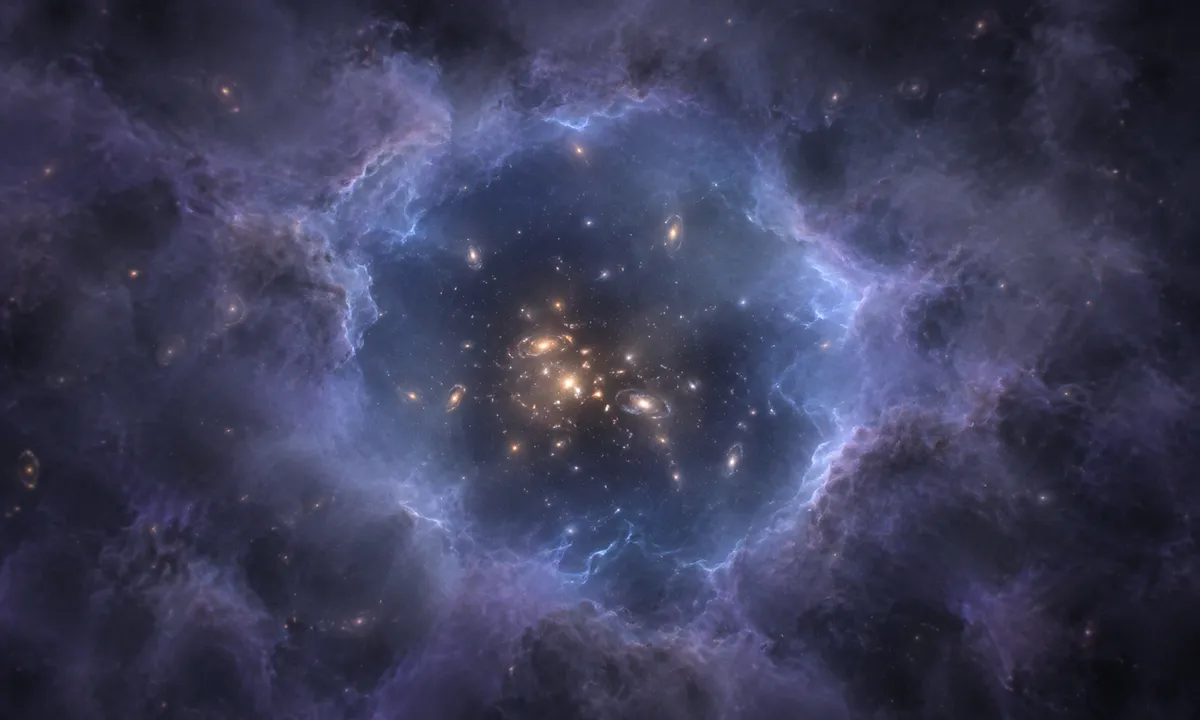
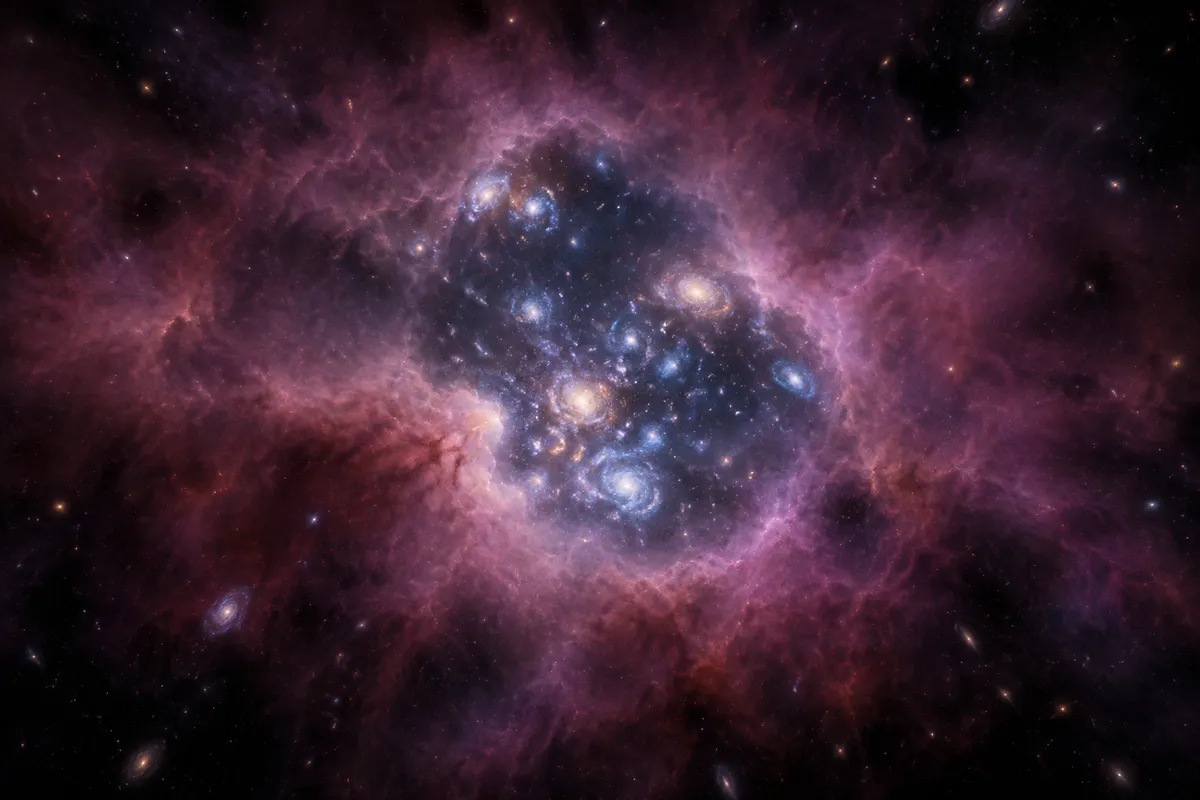
Astronomers using the James Webb Space Telescope have spotted a tight group of 18 galaxies, seen about 500 million years after the Big Bang, that may be carving out a large bubble of ionized hydrogen around themselves. The data comes from the JADES survey, and the finding was reported by Phys. If it holds up, it would be the earliest known ionized bubble produced by a galaxy overdensity, and it could offer some of the earliest evidence for how cosmic reionization began.
The universe, but foggy
Here's the setup. In the early universe, according to the standard picture of cosmology, the cosmos was not transparent to light the way it is now. Think of a dense fog rolling over a city at dawn. Something has to burn it off before you can see the skyline.
That burning-off is cosmic reionization, one of cosmology's biggest transitions, and it is how the universe became transparent to light. The open question is how it started. One candidate mechanism: clusters of early galaxies clearing out pockets of fog around themselves, bubble by bubble. This new group of 18 is a possible example of exactly that.
What an ionized bubble actually is
The reported discovery centers on a bubble of ionized hydrogen. Ionized simply means the hydrogen gas has been energized and changed in a way that lets light travel through it more freely. Picture the galaxies as a cluster of lanterns in a dim room. Alone, each one lights a little patch. Packed together, their glow overlaps and the clear zone gets bigger.
That is why density matters here. In a crowded neighborhood of galaxies, the combined effect may be enough to open a large clearing while the surrounding universe is still murky. It's hard not to see the appeal: the story is basically "the first neighbors on the block turned on their porch lights, and the whole street got brighter."
Why JWST keeps being the main character
JWST has spent its career rewriting the timeline of early galaxy formation, and this result adds a possible mechanism to a list of surprises. Fans of the telescope will recognize the pattern: look at a very young universe, find something more organized than anyone expected, and watch the textbooks get a sticky note.
Worth keeping straight: the "if confirmed" in the reporting is doing real work. What's on the table is a possible bubble and a possible mechanism, not a closed case. The takeaway from the coverage is promising, not settled.
Why this one is a big deal
The prize is the "earliest known" label. Should the bubble be confirmed, it would push back the earliest known example of a galaxy overdensity making an ionized bubble. That gives scientists something concrete to study in a part of cosmic history that's otherwise mostly theory and simulation.
There's also a lovely irony. We learn about the universe becoming see-through by looking at light from a moment when it was only starting to be. The galaxies are both the evidence and, possibly, the cause.
The Lyman-alpha puzzle
One thread flagged in the coverage is the mystery of Lyman-alpha light escaping the early universe. Lyman-alpha is a kind of light that astronomers use as a probe of early galaxies, and whether it can get out of the surrounding fog says something about how clear the space around a galaxy is. A bubble would be one way for such light to make it across to us. I'm drawing the connection loosely here, since the details of the measurements go beyond what's been reported, but it's easy to see why a cleared-out region would matter for that question.
The takeaway
We tend to think of darkness and light in the cosmos as a story of single, famous objects. This finding suggests the early universe may have been lit the way most things get done: by a crowd, in a neighborhood, working together. Eighteen galaxies, 500 million years after the Big Bang, and possibly the first group project to clear the air.