Your four-year-old has probably asked a smart speaker for a song about a dinosaur. Maybe it even delivered. According to a PBS report, researchers say that moment is a good opening for a bigger conversation: what, exactly, is the thing answering back?
PBS reports that experts are now offering guidance for parents of children under 8 on how to help them understand and safely interact with AI, including smart speakers and AI toys. The core message is that human interaction remains crucial for healthy development. Most parenting advice on AI, per the report, has focused on older kids, so this is an attempt to fill the gap during critical brain development years.
Why the preschool years matter
Lauren Girouard, a researcher at Harvard Graduate School of Education and the University of Michigan, said that by preschool age, a child can learn information from technology. That is the double-edged part. Kids can pick things up from a screen or speaker, which is exactly why parents may want to be deliberate about what they are picking up, and from whom.
AI is also already woven into the background of a kid's day, from Alexa to YouTube. Nobody had to sign the toddler up. It simply arrived, like glitter.
The angle worth committing to: turn the smart speaker into a teaching moment
Of the ideas in the report, the most practical is also the cheapest: use the smart speaker your family already owns to show the difference between a human response and a computer response.
The experts' guidance centers on plain, age-appropriate language that makes clear AI is not a person. The points highlighted in the report: it doesn't feel sad, it doesn't have a body, and it doesn't understand snuggling. That last one is quietly devastating, and also a useful way for a small child to grasp the gap. A speaker can answer a question about snuggling. It cannot be snuggled, and it cannot snuggle back.
Try it at home
This is my spin on how the advice could play out, not a script from the experts. Ask the speaker a question, then ask a family member the same one. Talk about what was different. Did Grandma laugh? Did she ask a follow-up? Did she remember that you hate pickles? Kids are natural comparison shoppers, and this gives them something real to compare.
Scaffolding: the unglamorous hero
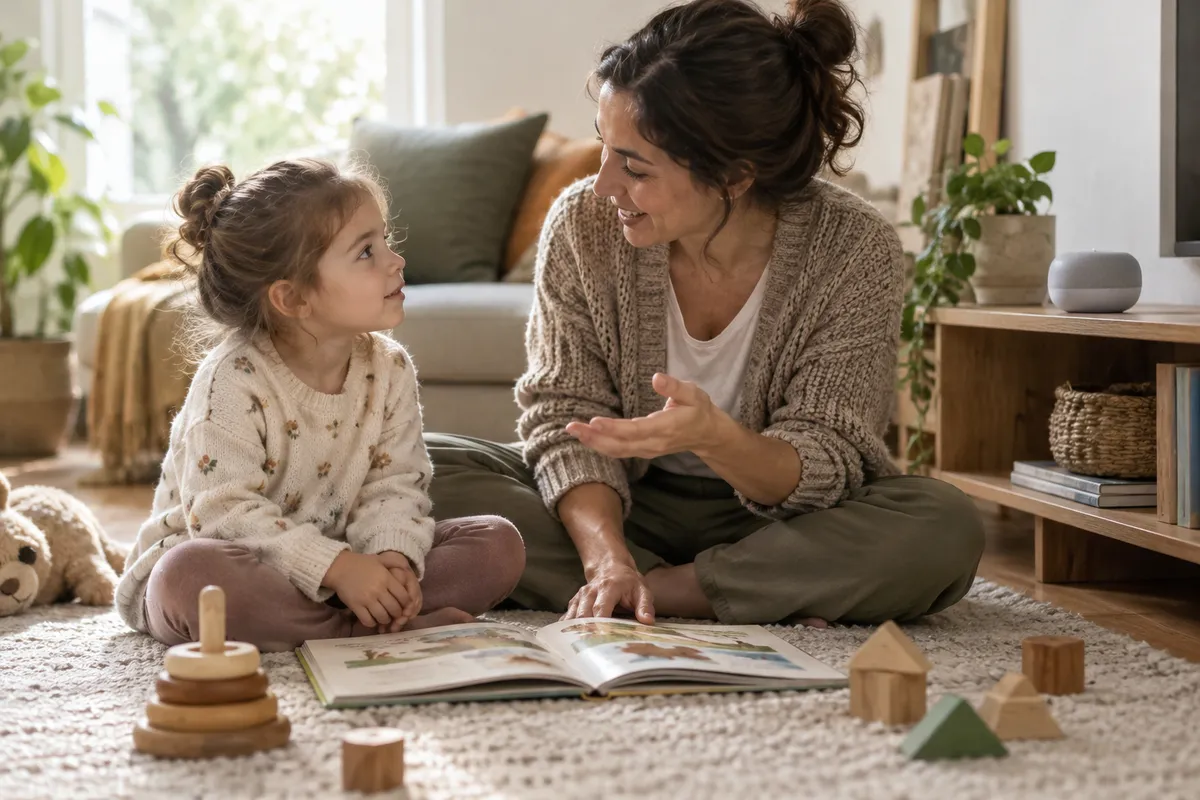
The report points to a concept called scaffolding, meaning learning guided by a human who adjusts support as a child goes. The experts' position, per PBS, is that human-guided learning beats AI interaction for language, emotional and social development.
It's hard not to notice how old-fashioned this sounds in the middle of a tech panic. The best tool for a preschooler's brain, in this telling, is still a grown-up who is paying attention. No subscription required, though batteries (coffee) may be.
AI toys and AI slop: two flags
The report also flags AI toys as posing developmental risks, and encourages parents to choose alternatives that prioritize human connection. The summary I have of the piece doesn't detail every risk or list specific products, so I won't guess at them. The takeaway is directional: a talking gadget isn't a substitute for a playmate or a parent.
Then there is low-quality, AI-generated children's content, the stuff critics call "AI slop." The coverage points parents toward spotting red flags in what their kids watch on platforms like YouTube. Specific warning signs weren't spelled out in the material I have, so rather than invent a checklist, the safest advice is the obvious one: watch a few minutes alongside your child and trust your gut when something feels off or oddly hollow.
What parents can take from it
- Name it. Tell kids plainly that AI is a computer, not a person.
- Compare it. Use the smart speaker you already have to show how human and computer answers differ.
- Stay in the loop. Guided, shared learning is where the developmental payoff is, according to the experts.
- Be skeptical of AI toys and mystery videos. Prioritize real human connection.
The sharpest takeaway
There's a certain irony in the fact that the most cutting-edge parenting advice of the moment boils down to: talk to your kid. But that's not a cop-out, it's the point. AI can answer a question in half a second. It still can't notice that your child asked it because they were really wondering whether the dog misses them. That part is yours.