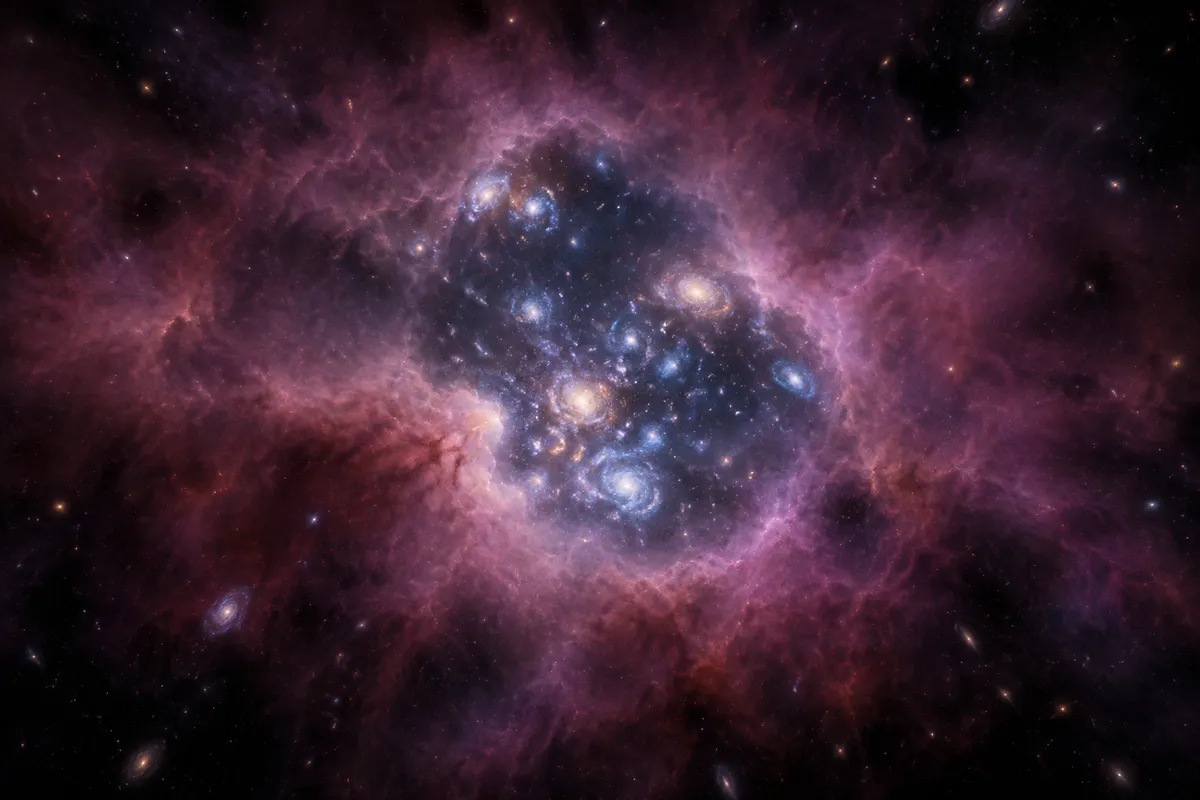
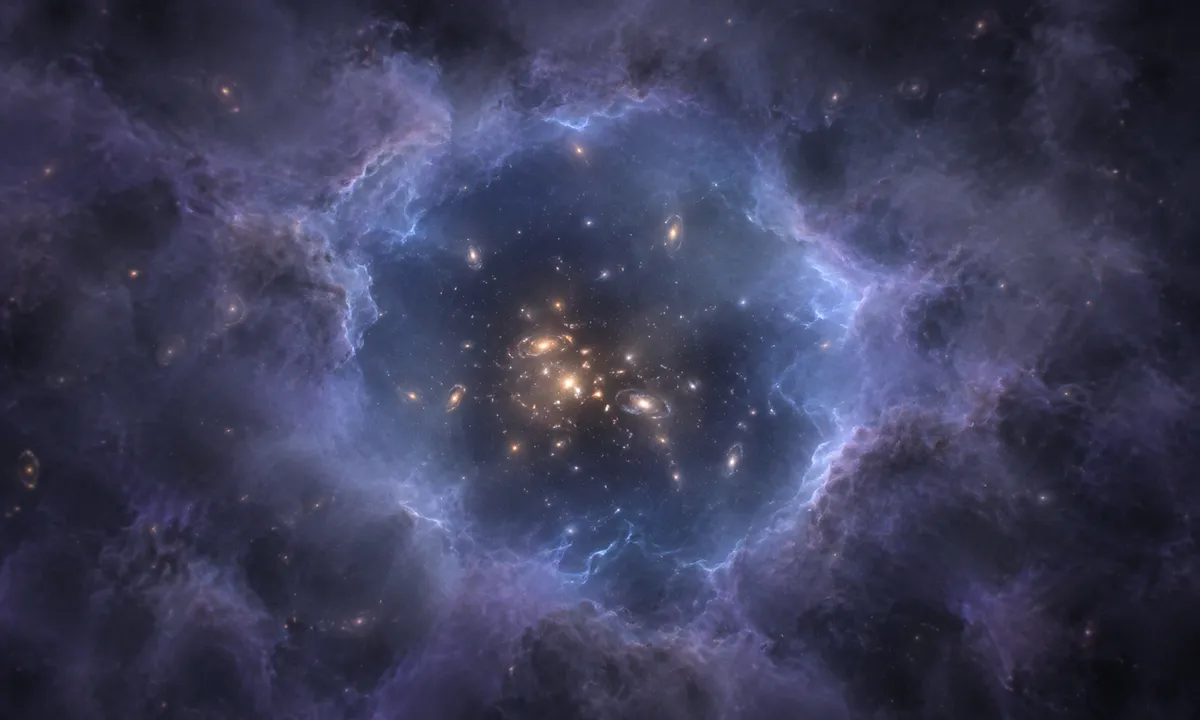
Here's a cosmic neighborhood story with real stakes. According to a report from Phys, data from the James Webb Space Telescope's JADES survey reveals a dense group of 18 early galaxies, seen about 500 million years after the Big Bang. Together, they may be creating a large bubble of ionized hydrogen.
If that holds up, it could offer some of the earliest evidence for how cosmic reionization began, the process by which the universe became transparent to light.
The Universe Used to Be Foggy
Picture the early universe as a room full of fog. Per Phys, the transition at issue is how the cosmos went from opaque to transparent, and reionization is the name for it. The leading idea is that early galaxies helped clear the haze, and this crowded cluster may be a snapshot of that happening.
A bubble of ionized hydrogen is, loosely, a cleared-out patch in that fog. The galaxies in the group are the likely carvers. That's the appealing visual: not a universe flipping on like a light switch, but neighborhoods lighting up first, one crowded block at a time.
Why the Crowd Matters
The detail that makes this find stand out is the density. Eighteen galaxies packed into one region is the sort of overdensity that could pool enough light to push back the fog on a large scale. It's hard not to read it as the cosmic equivalent of one very bright street in an otherwise dark town.
Per the report, if the finding is confirmed, it would be the earliest known ionized bubble produced by a galaxy overdensity. That's a big "if" and a big superlative, and the conditional phrasing is doing honest work. The result describes a possible mechanism, not a closed case.
Webb Keeps Rewriting the Early Timeline
This is another entry in a running theme. JWST has been steadily revising the timeline of early galaxy formation, and this discovery adds a potential mechanism for one of cosmology's biggest transitions. For anyone who has followed the telescope since launch, the pattern is familiar: look deeper, find the early universe busier than expected.
The reporting also points to a related puzzle, the question of Lyman-alpha light escaping the early universe. Lyman-alpha is a signature glow tied to hydrogen, and whether it can get out of such distant galaxies is tied up with how clear the surrounding space is. I'll leave the physics details to the researchers, since the coverage I'm drawing on only flags it as part of the mystery. But it's a good reminder that a ionized bubble isn't just a pretty idea; it's something astronomers can test by looking at what light makes it to us.
The Everyday Takeaway
It's a satisfying thought that the reason we can see the distant cosmos at all may trace back to crowded clusters of young galaxies doing what crowds do: making a lot of light. The sky we study is, in a sense, a view that early galaxies helped clear.
The finding still needs confirmation, and good science will insist on it. But even as a hypothesis, 18 galaxies burning a hole in the fog of the early universe is the kind of image that sticks, and it's a fine reminder that the biggest transitions in cosmic history may have started in a single, very bright neighborhood.