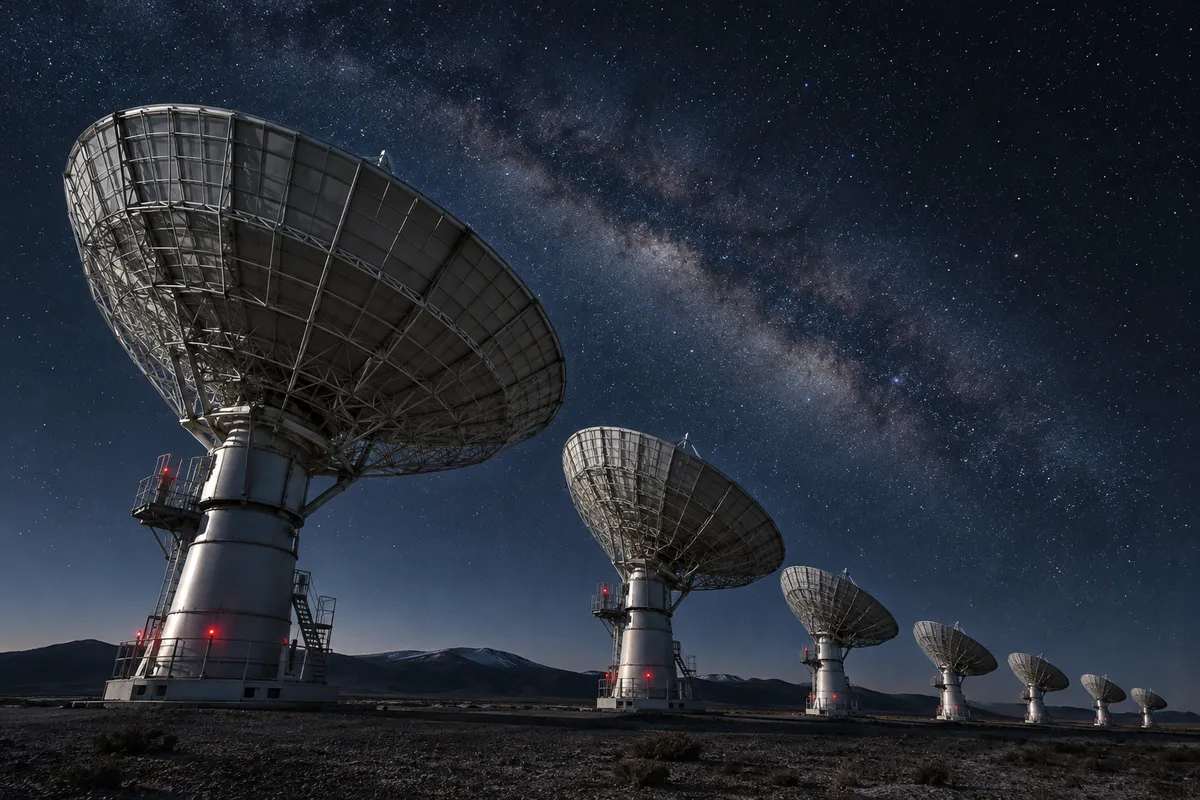
The Canadian Hydrogen Intensity Mapping Experiment, better known as CHIME, has shown for the first time that it can detect the faint glow of hydrogen gas from deep in the universe's past using only its own data, per a report from Phys. The result proves out a technique called hydrogen intensity mapping, which researchers hope can chart matter across the cosmos and help investigate dark energy.
In plain terms: a radio telescope in Canada has picked up a whisper from the early universe, and this time it didn't need anyone else's data to confirm it.
What actually happened
According to Phys, CHIME independently detected the faint radio glow of ancient hydrogen. That matters because hydrogen intensity mapping is meant to study cosmic expansion farther back in time, at larger scale, and at lower cost than traditional galaxy surveys.
The reported distinction is the "using only its own data" part. Earlier approaches to this kind of detection leaned on other datasets for support. Standing on its own is the difference between a promising idea and a working instrument.
Why a faint glow is a big deal
Dark energy remains one of physics' biggest unresolved questions, and cosmology is currently hunting for independent ways to test competing theories about how the universe evolves, per the report. Think of it as a second witness. If one method says the universe is expanding a certain way, you'd love a different method, with different quirks, to back it up or complicate the story.
Traditional galaxy surveys work by cataloguing individual galaxies. Hydrogen intensity mapping takes a different route: instead of counting each galaxy, it reads the combined radio glow of hydrogen gas and turns it into a map of where matter sits. It's the difference between counting every streetlight in a city and flying over at night to see the whole glowing grid.
That comparison is my own shorthand, not the researchers', but it captures why the approach is exciting. A blurry, big-picture map can cover a lot of sky and a lot of cosmic history without chasing down every faint object.
The cheap-seats advantage
The angle worth dwelling on is cost. Big astronomy usually means big budgets, and the report highlights that this method can reach farther back, at larger scale, and at lower cost than traditional galaxy surveys. In a field where headline instruments are famous for their price tags, a technique that gets more cosmic territory per dollar is a story in itself.
It's hard not to see the appeal for a scientific community that has more questions than telescopes. If radio glow can do part of the job that optical surveys do, dark energy research gets another door to walk through.
Proof takes time
One of the more relatable details in the coverage: the team reportedly had to spend a year proving the signal was real. Anyone who has ever double-checked a suspicious sound in a quiet house will sympathize. When your target is an extremely faint signal buried in a noisy sky, "we found it" is the start of an argument, not the end. Confirming it is the hard, unglamorous part, and it is exactly why this detection is a milestone rather than a headline grab.
What comes next
CHIME now has nearly seven years of data to expand this method, per Phys. That is a deep archive for a technique that has just proven it works. The detection shows the method is viable; the next step is using that long record to sharpen the picture of how matter has been distributed through cosmic history.
The result also gives Canada a prominent spot in a young corner of cosmology. A telescope built around mapping hydrogen has now demonstrated, on its own, that the idea holds up.
The takeaway
Dark energy is still unsolved, and nothing here changes that overnight. But the way scientists approach a mystery matters almost as much as the answer. Before this, hydrogen's distant glow was a promising theory. Now it's a measured signal, and the universe just got a little easier to listen to.