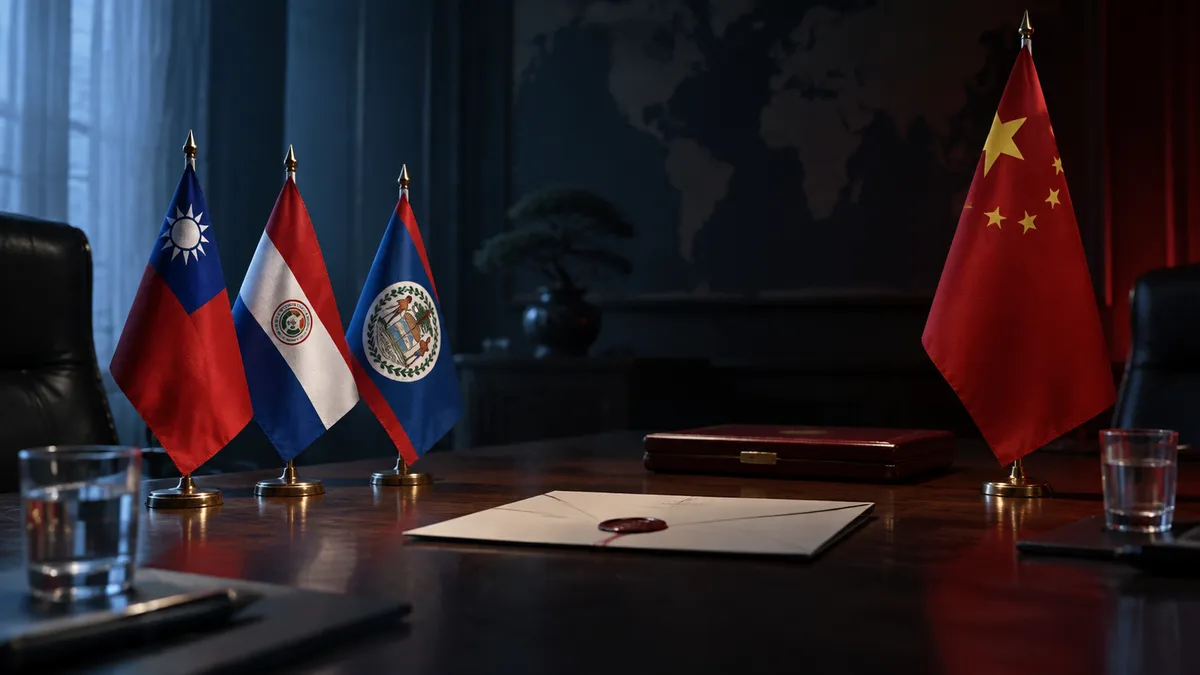
China has sanctioned two government ministers from countries that formally recognize Taiwan: Paraguay's communications minister, Gustavo Villate, and Belize's foreign minister, Francis Fonseca. Per Al Jazeera, the measures freeze assets and restrict entry to Hong Kong and Macau. The Chinese Foreign Ministry cited national sovereignty and Taiwan separatist activities as the reasons.
This report is a sober one, so the tone stays that way. The story is less about two officials than about what happens when two small countries get pulled into a much larger argument.
What happened
The sanctions target individuals, not whole countries. Villate and Fonseca are named, their assets are frozen, and their access to two Chinese-administered territories is limited. According to Al Jazeera, the move fits Beijing's broader campaign to isolate Taiwan and to penalize officials who publicly support it.
The Chinese Foreign Ministry's stated rationale, per the report, rests on two ideas: protecting national sovereignty and countering what it calls Taiwan separatist activities. That is Beijing's framing, and it is worth reading as exactly that.
Why the timing stands out
Al Jazeera notes the sanctions arrive just after Taiwan's National Day, and amid renewed rhetoric from China about "reunification." They also land as Taiwan strengthens its defense ties and capabilities, including recent deliveries of US fighter jets.
It's hard not to read the sequence as a message: a holiday that showcases Taiwan's separate identity, followed quickly by consequences for officials abroad who back it. Whether the timing was deliberate is not something the reporting establishes, so that part is inference.
Why small allies matter
The angle worth dwelling on is why Paraguay and Belize matter at all. Taiwan has 12 diplomatic allies, according to the report. At that number, each one carries real weight. Formal recognition is among the few ways Taiwan holds a seat in the world's diplomatic conversation, and every country that keeps it is a country Beijing has not yet persuaded to switch.
That makes allies a pressure point. Beijing cannot easily change what Taiwan's government does, but it can raise the cost for partners abroad. Sanctioning a foreign minister and a communications minister sends a signal to officials elsewhere about what public support may cost them personally.
Two very different officials
The choice of targets is interesting. Fonseca, as Belize's foreign minister, is the obvious face of his country's diplomacy. Villate, as Paraguay's communications minister, is a less conventional pick for a foreign-policy dispute. Al Jazeera's summary does not explain why these two were chosen over others, and it would be speculation to say. What the pairing does suggest is that Beijing is willing to reach beyond foreign ministries.
The great-power squeeze
For Paraguay and Belize, the dynamics are familiar to small states everywhere. They hold a relationship that matters to Taipei, while the world's second-largest economy objects to it. The practical tools Beijing can use, as the coverage describes the wider campaign, include sanctions, trade pressure and diplomacy aimed at shifting recognition.
The US factor sits behind all this. With American fighter jets recently delivered to Taiwan, per Al Jazeera, the standoff is not just a bilateral dispute. Each step on defense or diplomacy invites a response, and allies far from the Taiwan Strait can find themselves in the blast radius of that exchange.
What to watch
The open questions are straightforward. Will Paraguay or Belize respond publicly? Will Beijing extend the list to other officials? And will other countries that recognize Taiwan treat this as a warning or as a reason to dig in? None of those answers are in the reporting yet.
For now, the lesson is a quiet one. A dozen countries hold up a large part of Taiwan's formal standing in the world, and Beijing has just shown it is prepared to make that stance personal for the people who speak for it.