The popular image of an Egyptian mummy is pretty fixed: a royal figure, arms crossed, resting in an elaborately decorated sarcophagus. A new study suggests the reality was messier, more varied, and a lot more tender.
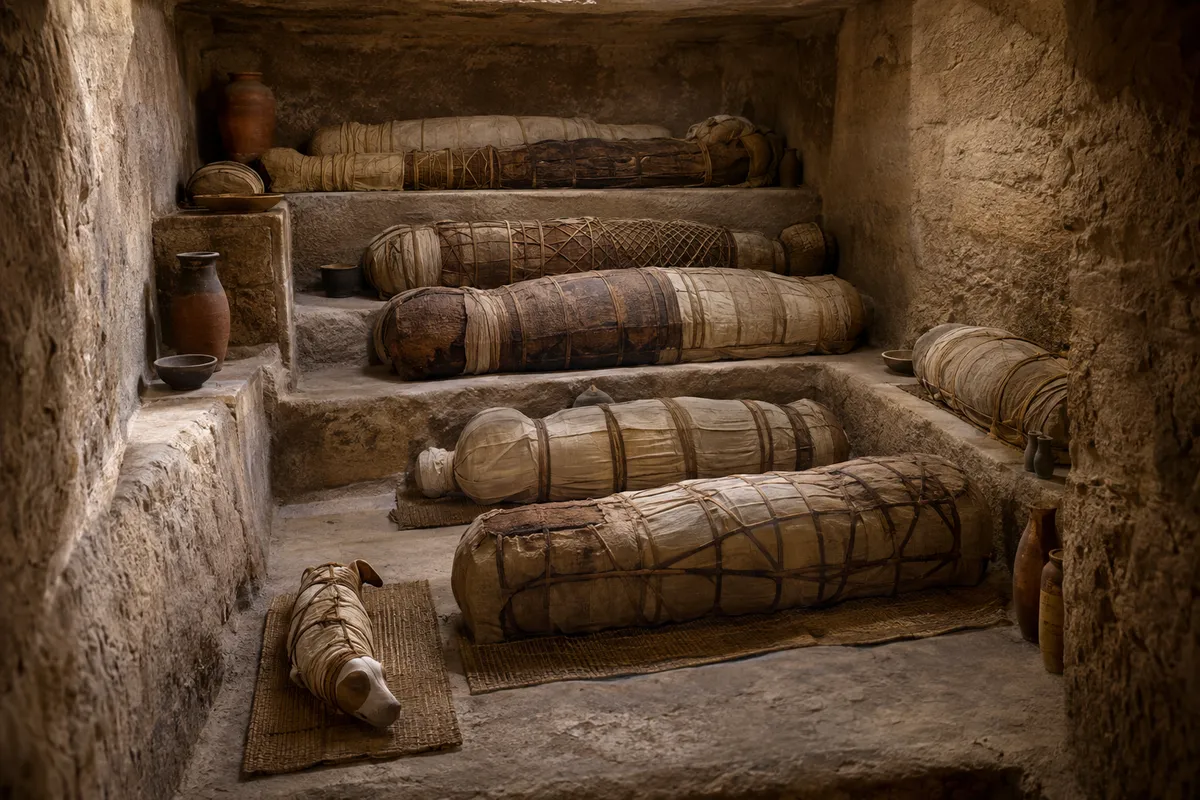
Per Popular Science, a team from Spain's University of La Laguna has documented at least 20 ancient Egyptians and one dog in chamber three of tomb TT 209, in the Theban Necropolis near Luxor. The findings were published in the journal Frontiers in Environmental Archaeology. The remains span more than 300 years, and the researchers argue the arrangement was no accident.
The "Messy Tomb" Theory Gets a Rewrite
The necropolis is a complex of over 400 burial sites, and TT 209 was first constructed during the 25th Dynasty (754–656 BCE), also known as the Nubian or Kushite Empire. Over the generations, it kept taking in the dead.
Older thinking held that some Egyptian burial sites grew more chaotic as they filled up. This team says that's not what happened here. Study co-author Jared Carballo-Pérez said in a statement that the detailed study of the bodies "indicates neither chaotic accumulation nor a loss of the original ritual over time." Instead, he described "a spatial logic in which each new deposition was adapted to the presence of previous bodies—a kind of funerary memory in the processes of reuse."
His conclusion: "deposits that were previously considered 'disordered' can be reinterpreted."
It's hard not to think of a family plot where later generations squeeze in around the ones who came first. Crowded isn't the same as careless.
How the Team Worked
Archaeologists excavated the tomb, then photographed and sketched its occupants and described each mummy's orientation and position within the structure. In total, they documented nine separate funerary deposits, containing both single and group burials, plus personal objects and religious items. Per the report, the timeline showed space inside the chamber becoming a premium as the years went on.
From Coffins and Amulets to Standing Room
The earliest burials look like what you'd expect from the postcard version of Egypt. Egyptologist and co-author Miguel Ángel Molinero Polo explained that these individuals "appear to have been of high social standing, as they were interred in coffins, with funerary nets and amulets, and with an assemblage containing costly items."
Then the practice shifted. By the end of the 25th dynasty (680–404 BCE), a stretch also known as the Persian period, attendants placed mummies wherever space allowed, sometimes requiring different limb positions. Almost two-thirds of the tomb's deceased were arranged vertically, rather than in the earlier tradition of individual interments.
This was not, the researchers say, a sign of fading respect. Many later mummies still had arms folded over their chests in what's known as the Osirian position. Molinero Polo noted that the vertically stacked bodies had no coffins but were carefully mummified, and can be associated with upright jars that point to "a specific ritual not found in the earlier phases of the tomb's use."
So the later residents may have lacked the fancy packaging, but the care was still there. That's a useful corrective for anyone whose mental model of ancient Egypt comes entirely from museum posters and movie sets, where every mummy seems to have been a pharaoh with a good publicist.
The Dog
Then there's the canine. In one instance, a mummified dog was placed directly on top of a man and a woman. A figure caption in the study notes the canid (labeled M9) lying over the lower limbs of two closely superimposed individuals, M6 and M7.
Carballo-Pérez was open about finding it moving. "I find it quite beautiful," he said. "This could indicate a close relationship between these human individuals and the animal, an idea that I think is quite easy to empathize with."
Note the careful phrasing: "could indicate." The study doesn't claim to know the dog's story, and neither can we. But anyone who has ever had a pet claim the best spot on the couch, or on top of you, may find the possibility easy to picture.
Why This Tomb Matters
What makes TT 209 appealing is that it compresses a long story into one room. Egyptian civilization lasted over 3,000 years, and the royal-in-a-sarcophagus pose is only one burial tradition among many. Normally, tracking how funerary rites shifted across generations might mean hopping between multiple sites. Here, a single chamber near Luxor offers a layered record, with the superstructure's protective covering and wall finishing completed at the end of the 2026 season, per the study's image credits.
The takeaway from Carballo-Pérez and Molinero Polo is a humane one: people reused this space for centuries, adapted to those who came before, and kept the rituals going in new forms. The old idea of a tomb stuffed with the forgotten gives way to something closer to a family album, with a dog somewhere in the pile of photos, right where it wanted to be.